
Holistic Diagnostics
Meridian Tooth Chart — See What Your Teeth Reveal About Your Health
Look up any of your 32 teeth and see the organs, glands, joints, and vertebrae they connect to. Then go further than a chart ever can: our biological dentists in Spring, TX — serving The Woodlands, Tomball, Klein, and North Houston — use meridian analysis and Dental Bioelectrical Assessment to tell you what your teeth are actually doing to your body.
- ✓ Free interactive tooth-organ map, no signup needed
- ✓ In-office meridian evaluation with 3D CT and DBA testing
- ✓ IAOMT/IABDM-trained doctors, whole-body treatment plans

Benefits at a Glance
Tooth-Organ Mapping
Each tooth corresponds to specific organs, glands, and body systems via energy meridians.
Whole-Body Diagnosis
Helps identify how dental conditions may contribute to systemic health issues.
Treatment Insight
Guides holistic treatment planning by revealing connections between oral and systemic health.
Rooted in Tradition
Based on Traditional Chinese Medicine meridian theory used for thousands of years.
Bioelectrical Assessment
Our DBA system measures the bioelectrical energy connections of your teeth.
Personalized Care
Findings are integrated into your unique, comprehensive treatment plan.
The meridian tooth chart is a comprehensive diagnostic reference used in holistic and biological dentistry to map the tooth-body connection — the energetic links between each of your 32 teeth and specific organs, glands, joints, and body systems throughout the body. At Holistic Dental Associates in Spring, TX, the chart is an integral part of our whole-body diagnostic approach, helping our doctors understand how conditions in your mouth may be affecting your overall health and why patients across The Woodlands, Tomball, and North Houston use it as a starting point for oral-systemic evaluation.
Try the Interactive Meridian Tooth Chart
Tap or click any tooth to instantly see its meridian, connected organs, glands, joints, and vertebrae — the same chart our doctors use during your evaluation.
Free to explore — no signup or download needed.
How to Use This Interactive Chart
- Open the interactive chart — tap or click any tooth above to see its meridian and connected organs instantly.
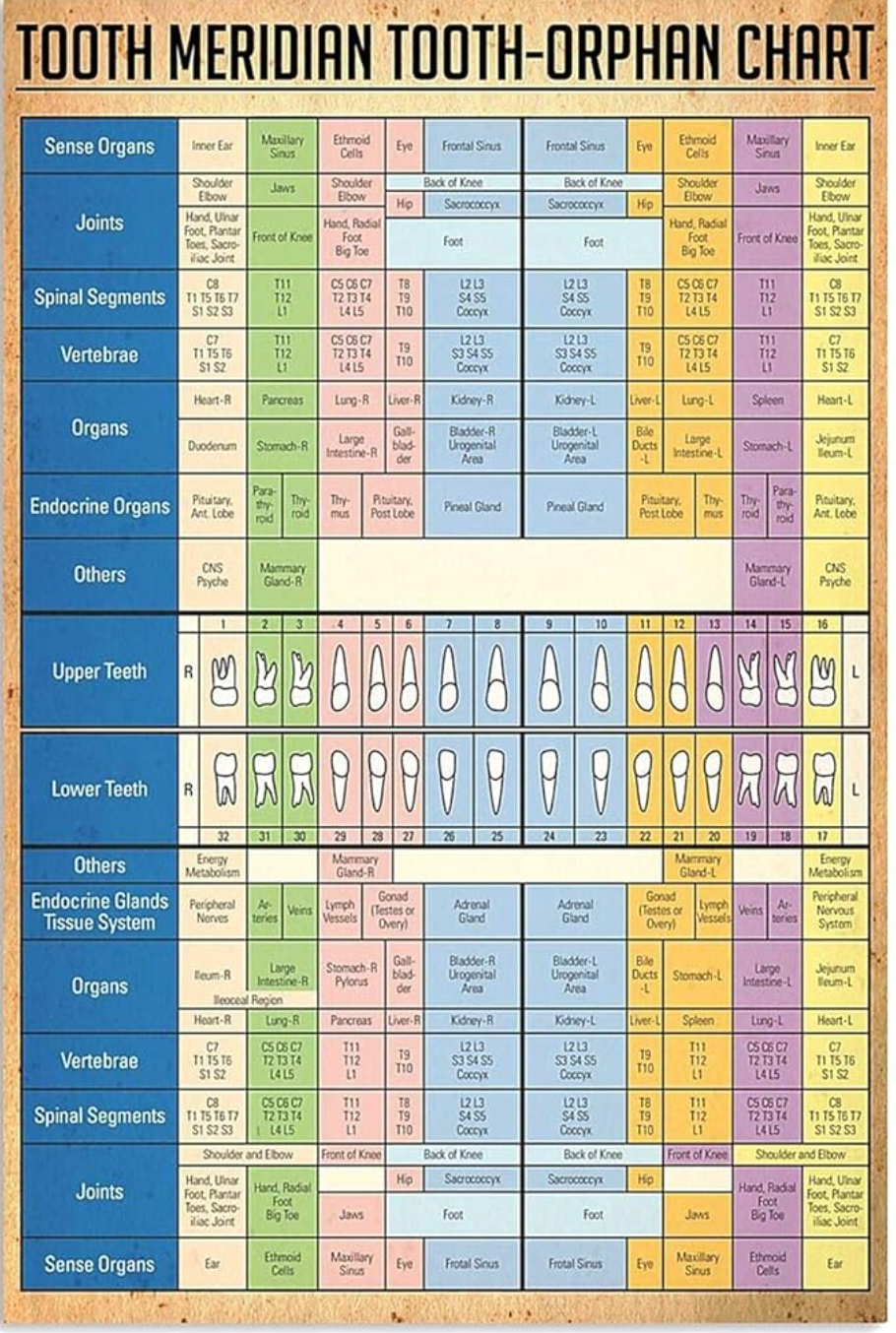
- Find your tooth number — use the universal numbering system (1–32) shown on the reference chart below.
- Match the meridian group — scroll down to the reference table to see which meridian that tooth belongs to.
- Read the connected organs & body systems — each row lists the organs, glands, joints, and vertebrae associated with that meridian.
- Talk to a holistic dentist — if a tooth on that meridian is infected, root-canaled, or contains toxic material, it may be worth a whole-body evaluation.
How the Meridian Tooth Chart Works
According to Traditional Chinese Medicine, the body's vital energy (qi) flows through pathways called meridians. Each tooth sits on a specific meridian that connects it to distant organs and tissues. When a tooth is infected, has a toxic restoration (such as a mercury amalgam filling), or contains a dead nerve (as in a root canal), that interference can potentially affect the organs and systems on the same meridian.
For example, the upper front incisors are associated with the kidneys and bladder. The lower first molars connect to the lungs and large intestine. The wisdom teeth are linked to the heart and small intestine. These connections help explain why a patient with a chronic health issue may find improvement after addressing a dental problem on the corresponding meridian.
What Each Meridian Group Reveals About Your Health
The chart organizes all 32 teeth into five major meridian groups. Reading the chart by group — not just tooth by tooth — is where the real health insights live, because patterns across a whole meridian often tell a clearer story than a single problem tooth.
Kidney / Bladder Meridian
Incisors — upper #7–10, lower #23–26
Your eight front teeth sit on the kidney and bladder meridian — the meridian Traditional Chinese Medicine associates with bone tissue, skeletal strength, hearing, and the adrenal stress response. In meridian theory, a chronically infected or root-canaled incisor can act as an interference field for the kidneys, bladder, or urogenital system, and retrograde bacteria around a failing front tooth keep that meridian under constant low-grade load. This group is also linked to the frontal sinuses, the lower lumbar spine, sacrum and coccyx, and the adrenal glands — which is why patients with long-standing lower-back pain, sinus pressure, or unexplained fatigue often ask what their incisors reveal. In our Spring, TX office we pair this group with 3D CT imaging of the anterior jaw and a review of any prior root canal treatment before drawing conclusions.
Liver / Gallbladder Meridian
Canines (eye teeth) — #6, #11, #22, #27
The four canines connect to the liver and gallbladder meridian and, notably, to the eyes — which is how they earned the name “eye teeth.” In TCM, the liver governs detoxification, hormonal balance, and eye health, so a chronic infection or toxic restoration on a canine is often discussed alongside sluggish detox patterns, skin flare-ups, or persistent visual strain. Meridians in this group are also associated with the hips, the back of the knees, and the mid-thoracic spine (T8–T10), giving a problematic canine more systemic relevance than its small size suggests. When a canine shows up on the chart, our team reviews the tooth's restoration history and vitality alongside your health history rather than treating the mapping as a diagnosis.
Lung / Large Intestine Meridian
Upper premolars #4–5, #12–13 · lower first & second molars #18–19, #30–31
This group pairs the upper premolars with the lower molars — the largest group on the chart. These teeth share a meridian with the lungs and large intestine, the two organs Traditional Chinese Medicine associates with immune defense, respiration, and elimination, and which modern oral-systemic research connects to inflammation markers and gut dysbiosis. The connection extends to the shoulders, elbows, big toes, and the cervical (C5–C7), upper-thoracic (T2–T4), and lower-lumbar (L4–L5) spine, so dental interference here is often explored alongside chronic respiratory issues, skin conditions, shoulder pain, and sluggish elimination. For this group we look closely at old amalgam and crown margins on the lower molars, since replacing them safely is often the first practical step.
Stomach / Spleen / Pancreas Meridian
Upper first & second molars #2–3, #14–15 · lower premolars #20–21, #28–29
Upper molars and lower premolars map to the digestive trio of stomach, spleen, and pancreas — the meridian group most often discussed in relation to blood-sugar balance, digestion, and the thyroid and parathyroid glands. Because the upper molar roots sit directly beneath the maxillary sinuses, infection here can also drive recurrent sinus complaints that never resolve with typical treatment. These teeth additionally relate to the jaw joints (TMJ), the lower thoracic and upper lumbar spine (T11–L1), the gonads, and lymphatic drainage of the head and neck. Patients with persistent digestive, metabolic, or thyroid concerns frequently want to know what a failing or root-canaled upper molar on this meridian may be contributing. We routinely check the maxillary sinus floor on 3D imaging for these upper molars, because sinus involvement changes the treatment sequence.
Heart / Small Intestine Meridian
Wisdom teeth (third molars) — #1, #16, #17, #32
The wisdom teeth sit on the heart and small intestine meridian — a group also linked to the central nervous system, the anterior pituitary gland, and the heart itself. This is one reason impacted or infected third molars, and the cavitations (areas of dead jawbone) that can follow their extraction, receive careful whole-body consideration in biological dentistry rather than being treated as an isolated surgical event. The meridian also reaches the shoulders, elbows, ulnar side of the hands, the sacroiliac joint, and the C7–T1, T5–T7, and S1–S3 spinal segments — connections some patients explore when cardiac palpitations, neurological symptoms, or low-back and SI-joint pain have no other clear explanation. Before any third-molar or cavitation discussion, we confirm findings with 3D CT imaging and review them with you at your new patient consultation.
Complete Meridian Tooth Chart Reference
Use this quick-reference table to look up any tooth by its universal number and see the meridian it sits on, the organs and glands it connects to, and the joints and vertebrae associated with it.
| Meridian Group | Teeth (Universal #) | Connected Organs & Glands | Related Joints | Vertebrae |
|---|---|---|---|---|
| Kidney / Bladder Meridian | Incisors — upper #7–10, lower #23–26 | Kidneys, bladder, urogenital area; pineal gland (upper), adrenal glands (lower) | Back of knee, sacrococcyx, foot | L2–L3, S3–S5, coccyx |
| Liver / Gallbladder Meridian | Canines (eye teeth) — #6, #11, #22, #27 | Liver, gallbladder, bile ducts; pineal gland (upper), adrenal glands (lower) | Hip, back of knee, sacrococcyx, foot | T8–T10 |
| Lung / Large Intestine Meridian | Upper premolars #4–5, #12–13 · lower first & second molars #18–19, #30–31 | Lungs, large intestine; thymus and posterior pituitary (upper), arteries and veins (lower) | Shoulder, elbow, hand (radial side), big toe | C5–C7, T2–T4, L4–L5 |
| Stomach / Spleen / Pancreas Meridian | Upper first & second molars #2–3, #14–15 · lower premolars #20–21, #28–29 | Stomach, spleen, pancreas; thyroid and parathyroid (upper), gonads and lymph vessels (lower); mammary glands | Jaws, front of knee | T11–L1 |
| Heart / Small Intestine Meridian | Wisdom teeth (third molars) — #1, #16, #17, #32 | Heart, duodenum, jejunum, ileum; anterior pituitary; central nervous system | Shoulder, elbow, hand (ulnar side), sacroiliac joint | C7–T1, T5–T7, S1–S3 |
Mappings follow the Tooth Meridian Chart used in biological dentistry, based on the Traditional Chinese Medicine meridian system.
Common Tooth–Organ Connection Questions
These are the tooth-to-organ questions patients ask most often when they first explore the meridian tooth chart. Each answer points back to the interactive chart above so you can see the connection for yourself.
Which teeth are connected to the heart?
The four wisdom teeth (third molars #1, #16, #17, #32) sit on the heart and small intestine meridian. That meridian also links to the central nervous system and anterior pituitary — one reason biological dentists look carefully at impacted wisdom teeth and post-extraction cavitations when patients report unexplained systemic symptoms.
What organ are the front teeth (incisors) connected to?
All eight incisors — upper #7–10 and lower #23–26 — map to the kidney and bladder meridian, with links to the adrenal glands, pineal gland, lower back, and sacrum. A chronically infected or root-canaled front tooth is often discussed alongside kidney, bladder, or low-back complaints in meridian theory.
Which teeth are linked to the sinuses?
The upper first and second molars (#2–3, #14–15) sit on the stomach/spleen/pancreas meridian, and their roots lie directly beneath the maxillary sinus floor. Infection in these teeth is a well-known driver of recurrent sinus problems — which is why we image the sinus floor with 3D CT before treating upper molars.
Why are canine teeth called "eye teeth"?
The four canines (#6, #11, #22, #27) connect to the liver and gallbladder meridian — and, in Traditional Chinese Medicine, to the eyes. That connection earned them the nickname "eye teeth," and it's why a problem canine sometimes comes up in conversations about detox patterns, skin issues, or eye strain.
Can a root canal or infected tooth affect other organs?
In meridian theory, yes — a dead or infected tooth is considered an "interference field" that can place a constant low-grade burden on every organ sharing its meridian. Modern oral-systemic research echoes part of this idea, linking chronic dental infection to inflammation elsewhere in the body. The chart is a starting point for questions, not a diagnosis: our biological dentists confirm any suspicion with examination and 3D imaging.
Found Your Tooth on the Chart? Here's the Next Step
A lookup table can show you which meridian a tooth sits on — only a biological dentist can tell you what it's doing to the rest of your body. These are the pages most visitors continue with:
Meridian Tooth Chart Evaluation in Spring & The Woodlands, TX
A chart can show you the connections — but only an exam can tell you what they mean for you. Patients visit Holistic Dental Associates from Spring, The Woodlands, Tomball, Klein, Cypress, and across North Houston for a whole-body dental evaluation that goes far beyond a chart reference:
- Dental Bioelectrical Assessment (DBA) — objective measurement of each tooth's meridian energy
- 3D CT imaging — reveals hidden infections, cavitations, and failed root canals the chart hints at
- A 60–90 minute doctor consultation — your findings mapped to the meridian chart and explained in plain language
If a tooth on this chart lines up with a health issue you've been chasing, that's exactly the conversation our biological dentists have every day. Our Spring, TX office is minutes from I-45 and the Hardy Toll Road, an easy drive from The Woodlands, Klein, and Tomball.
How Our Spring, TX Holistic Dentists Use the Meridian Chart
At Holistic Dental Associates in Spring, TX — serving The Woodlands, Tomball, Klein, and the greater North Houston area — the meridian tooth chart is one of several diagnostic tools we use to evaluate your oral-systemic health. During your comprehensive exam, our doctors consider meridian connections when evaluating infections, failed root canals, cavitation lesions, and toxic dental materials.
We also use our Dental Bioelectrical Assessment (DBA) system, which measures the bioelectrical energy in your teeth — similar to how an EEG measures brain waves or an EKG measures heartbeats. This technology provides objective data about the energetic status of each tooth and its meridian connections.
When we identify a dental issue on a meridian that corresponds to a patient's chronic health complaint, it opens an important conversation about how addressing the dental problem may support improvement in overall health. This is the essence of biological dentistry: treating the mouth as part of the whole body.
The Tooth-Body Connection: What Science Says
The tooth-body connection describes the relationship between oral health and the health of distant organs and systems. Even outside meridian theory, mainstream medical journals now document that oral infection, inflammation, and toxic dental materials can contribute to conditions throughout the body.
Heart disease and periodontal infection
Gum disease bacteria can enter the bloodstream and contribute to arterial inflammation, making periodontal health a known risk factor for cardiovascular disease. Patients with chronic periodontitis often show elevated inflammatory markers.
Diabetes and oral inflammation
High blood sugar weakens the body's ability to fight oral infection, and severe gum disease can make blood sugar harder to control. Treating one often improves the other, illustrating a two-way tooth-body connection.
Mercury amalgam fillings and systemic burden
Mercury is a neurotoxin and some patients report neurological, immune, or fatigue symptoms that improve after safe amalgam removal. The mouth is not isolated from the rest of the body — what sits in a tooth can affect the whole person.
Root canals and focal infection
A tooth with a dead nerve can harbor bacteria that migrate along the corresponding meridian and may contribute to symptoms in the associated organ or joint. Biological dentists evaluate root-canaled teeth carefully when patients have unresolved systemic complaints.
Cavitations and hidden jaw infection
Cavitations are areas of necrotic bone left after extraction, often from wisdom teeth removal. They can harbor low-grade infection that affects the jaw and, through the meridian connection, distant organs and joints.
The Oral-Systemic Health Connection
Even conventional medicine now recognizes the profound connections between oral health and systemic health. Periodontal disease is linked to heart disease, diabetes, Alzheimer's, and adverse pregnancy outcomes. Mercury from amalgam fillings is a known neurotoxin. Chronic jawbone infections (cavitations) can harbor bacteria that affect distant organs.
The meridian chart provides an additional framework for understanding these connections. While the scientific community continues to research the mechanisms behind tooth-organ relationships, the clinical observations made by biological dentists over decades align with the growing body of evidence connecting oral health to whole-body wellness.
What to Expect During Your Meridian Tooth Chart Visit
Comprehensive Records
3D CT scan, digital X-rays, photos, and complete data gathering at your records appointment.
Dental Bioelectrical Assessment
DBA system measures the bioelectrical energy connections of each tooth on its meridian.
Meridian Analysis
Your doctor maps dental findings to the meridian chart, identifying potential oral-systemic connections.
Comprehensive Exam Discussion
During your 60–90 minute exam, your doctor explains all findings, including meridian connections relevant to your health.
Integrated Treatment Plan
Meridian insights are incorporated into your personalized treatment plan alongside all other diagnostic findings.
Why Choose Holistic Dental Associates
- Meridian tooth chart analysis integrated into comprehensive evaluation
- Dental Bioelectrical Assessment (DBA) for objective meridian energy data
- IAOMT/IABDM-certified doctors trained in biological and holistic dentistry
- Oral-systemic health evaluation connecting mouth conditions to whole-body wellness
- 3D CT scanning, salivary testing, and sleep study as part of new patient records
- Whole-body approach: we treat root causes, not just symptoms
"The meridian tooth chart opened my eyes to connections I never knew existed. When Dr. Scott showed me that my problematic tooth was on the same meridian as the organ I'd been having trouble with, it all started to make sense. Holistic dentistry is the real deal."
— Patient at Holistic Dental Associates
Frequently Asked Questions
Proudly Serving Greater Houston
Schedule Your Meridian Tooth Chart Consultation Consultation
Experience the difference of holistic, whole-body dental care at Holistic Dental Associates in Spring, TX.